Do You Have Your Bag of Bags?
Do You Have Your Bag of Bags?
There’s a surprisingly easy way to reduce plastic bag waste in Lake County…
It starts with a simple errand. You pop into the store for just a few things. Milk, maybe some bananas, that pack of ice cream bars you told yourself you weren’t going to buy again… Then you’re at the checkout, the cashier is already reaching for a plastic bag, and somewhere in the back of your mind you think: I have about forty reusable bags at home. I just don’t have any of them here.
Sound familiar? You are not alone. In fact, you are in very good company, because this happens to almost everyone. It does not mean you are careless or indifferent. It just means that it’s really easy to forget your reusable bag.
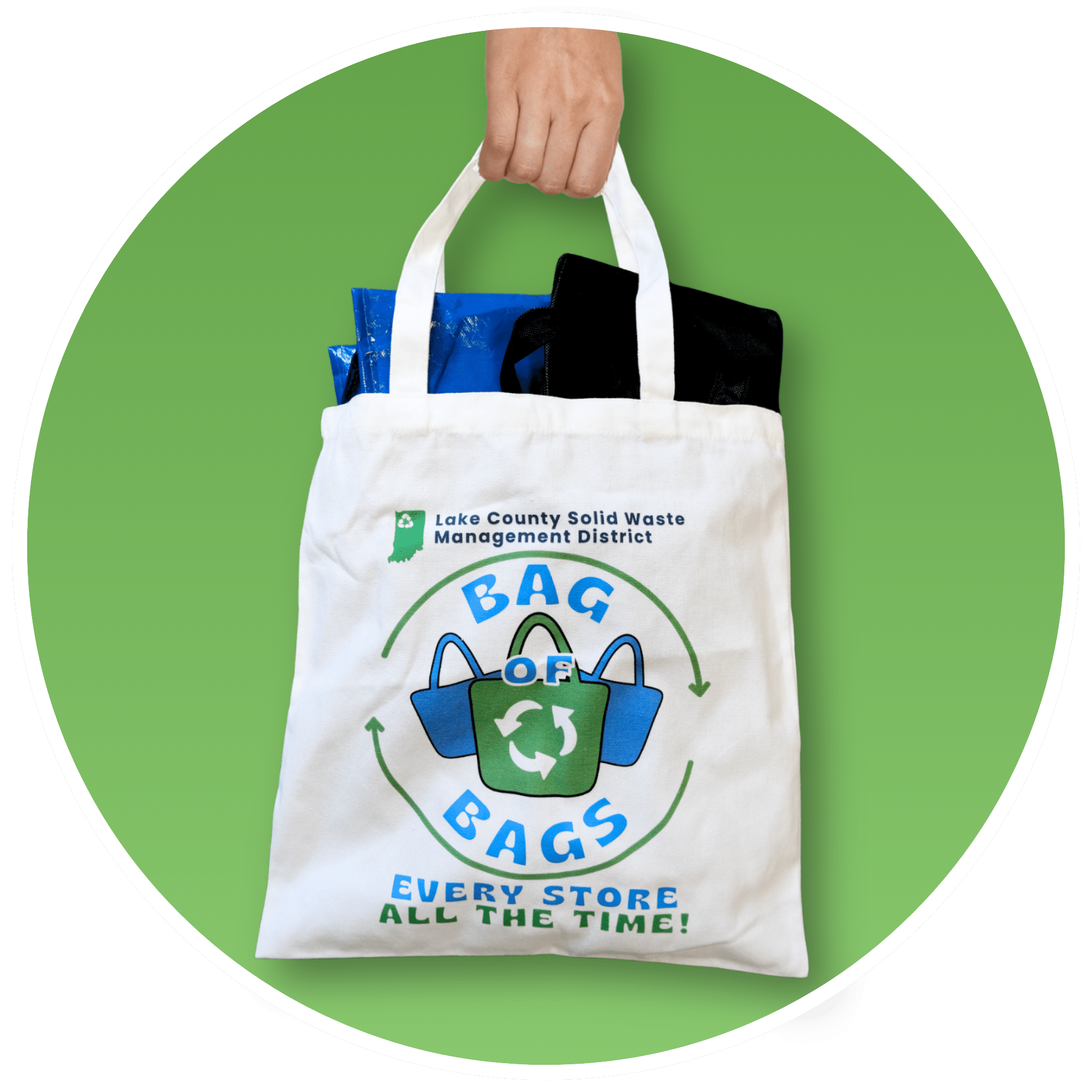
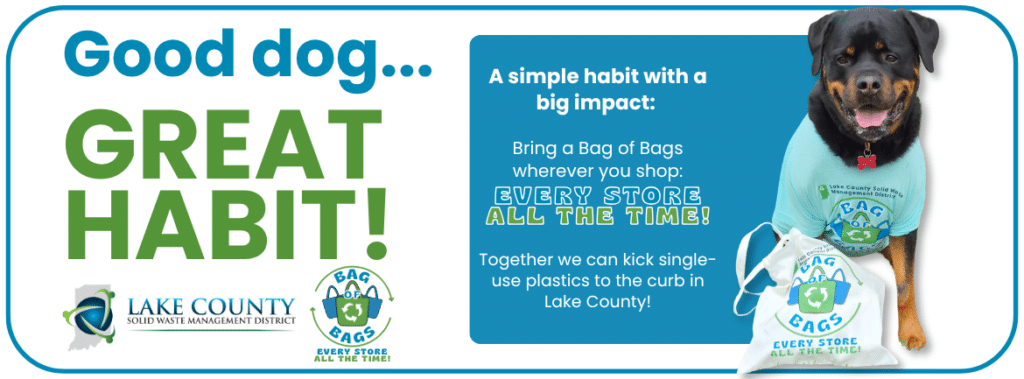
That is exactly the problem the Lake County Solid Waste Management District is trying to solve with our new Bag of Bags campaign. The idea is almost embarrassingly simple:
Keep a bag filled with reusable bags in your car, by your door, or wherever you will remember it. That way you are ready to refuse plastic bags at…
Every store, all the time!
Before we get to the good stuff, though, let’s talk about why this habit matters so much, because plastic bags are not nearly as harmless as they may seem…
Small Bag, Big Problem
Plastic bags have a way of feeling inconsequential. They are lightweight, they are free, and they are everywhere. You use one, you toss it, and it is gone. Out of sight, out of mind.
But that convenience is an illusion. Plastic bags are designed for a very short life and a very long afterlife. The problem, it turns out, starts long before the bag even reaches the store shelf.
Plastic Bags Begin as Oil
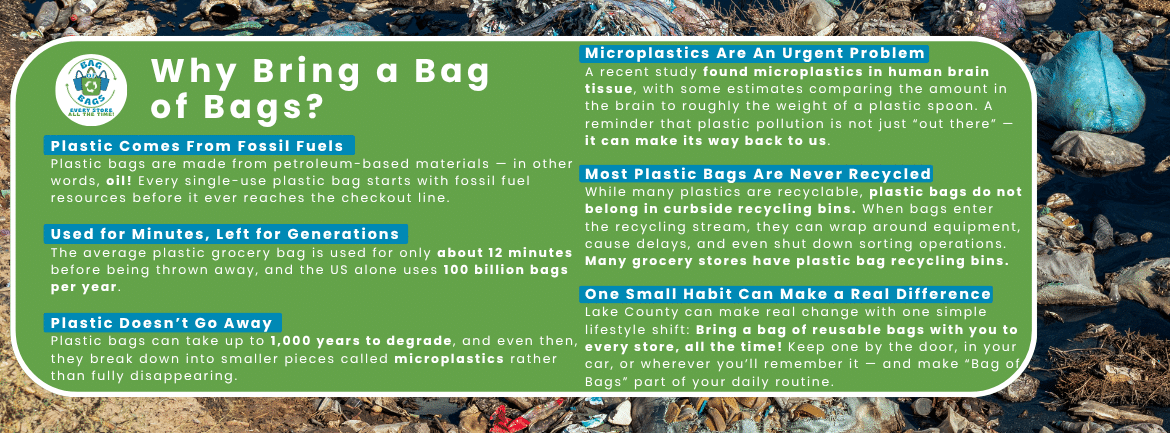
Here is something that does not come up enough in conversation: plastic bags are a petroleum product. They are made from fossil fuels…yep, oil. This means that before a single bag is used to carry your groceries home, crude oil has already been pulled out of the ground to make it.
The United States alone uses 12 million barrels of oil per year just for plastic bag production. Every single-use plastic bag carries an environmental cost that begins at extraction, and that cost does not end when the bag is disposed.
Twelve Minutes of Use, Centuries of Consequences
On average, a plastic grocery bag is used for about 12 minutes. That’s it. Twelve minutes to carry sometimes just a single item from the checkout to your car to your kitchen counter. Then the bag gets wadded up and shoved somewhere, or tossed in the bin, and that is that…Except it’s not.
That 12 minute-old bag does not disappear. It sticks around in ways that are genuinely hard to wrap your head around. Plastic does not break down the way organic materials do. It fragments, it persists, and once it is out in the environment it is extraordinarily difficult to recover.
12 minutes of use. Centuries in the ground. That mismatch is the whole problem.
A Thousand Years Is a Long Time
Plastic bags can take up to 1,000 years to degrade, and when we say “degrade,” we do not mean they quietly vanish into the earth. What actually happens is that they break into smaller and smaller pieces, and those pieces break into even smaller pieces, until eventually you have particles so tiny they are invisible to the naked eye.
Those particles are called microplastics, and they are now essentially everywhere. In soil. In water. In the air. In the food we eat and the water we drink. Researchers are still working to fully understand what long-term microplastic exposure means for human health, but what they are finding is not particularly reassuring.
Microplastics Are Closer Than You Think
A 2025 study from the University of New Mexico found microplastics in human brain tissue samples, with some estimates suggesting an average accumulation of roughly 7 grams per person. To put that in perspective, that equates roughly the weight of a plastic spoon inside the human brain. Researchers are still studying what this means for long-term human health, but the finding underscores something important: plastic pollution does not stay “somewhere else.” It has a way of coming back to us.
Here is another uncomfortable truth: around 87% of plastic bags are never recycled. The vast majority end up in ecosystems, waterways, and oceans, where they entangle wildlife, enter the food chain, and eventually break down into those microplastics.
That is not meant to send anyone into a spiral. It is meant to illustrate that this is not just an abstract environmental issue happening somewhere else. It is an extremely local public health concern.
Okay. Now for the Good News
The Bag of Bags concept is not meant to be a total lifestyle overhaul. It is not a major commitment or a significant expense. It is simply this: take all those reusable bags you already own, put them inside one of them, and keep that bag somewhere you will actually see it before you leave the house. In your car. On a hook by the front door. In your bike basket or stroller or backpack. Wherever makes sense for how you move through your day.
The goal is to stop relying on memory in the moment, because in the moment, you are thinking about your grocery list and whether you need to stop for gas. The Bag of Bags idea aims to remove that moment of decision entirely. The bags are already there. They go where you go.
Think about how many times a week this would actually come in handy. Grocery runs, pharmacy stops, farmers markets, pet stores, hardware stores, quick errands, school events. One simple habit covers all of it.
Why Lake County Is Focusing on this Now
As your county-level solid waste management district, our job is to help Lake County residents make practical choices that reduce waste, protect local ecosystems, and keep our community clean and healthy. We genuinely believe this one habit can make a real, measurable difference, and we want to make it as easy as possible for Lake County to get there together.
That is why we are launching the Bag of Bags campaign with real, local outreach: posters going up throughout the community, educational seminars, handouts and flyers with the facts, reusable bag giveaways, and a presence at community events throughout the county. We want to meet people where they are and make this as simple and accessible as possible.
This campaign is for everyone. Families with young kids. Seniors. Commuters. Pet owners. Local businesses and their employees. If you shop anywhere in Lake County, this campaign is talking directly to you!
We want to be clear: nobody has to be perfect. The goal is not a flawless record. The goal is to remember more often than you forget, and to gradually make the right choice the automatic one. Lasting change almost always starts with a small routine that eventually becomes second nature. The Bag of Bags is that routine!
Here’s Your Call to Action, Lake County
Start today. Gather up your reusable bags, stuff them into one bag, and put that bag somewhere it will actually go with you.
- Keep one in your car.
- Keep one by the front door.
- Keep one wherever you’ll actually remember it!
That’s the entire idea. That is the Bag of Bags, and if enough people in Lake County do it, we will use measurably fewer single-use plastic bags, put less strain on our recycling systems, and contribute to a healthier environment for everyone who lives here!
If you are interested in having the Lake County Solid Waste Management District participate in your community event, speak at your organization, school, or business, or bring Bag of Bags materials to your group, we would love to hear from you. Reach out to us directly and let’s talk about how we can reduce plastic bag usage together!
Lake County can make real change with one simple lifestyle shift. Bring a bag of reusable bags with you, to every store, all the time!